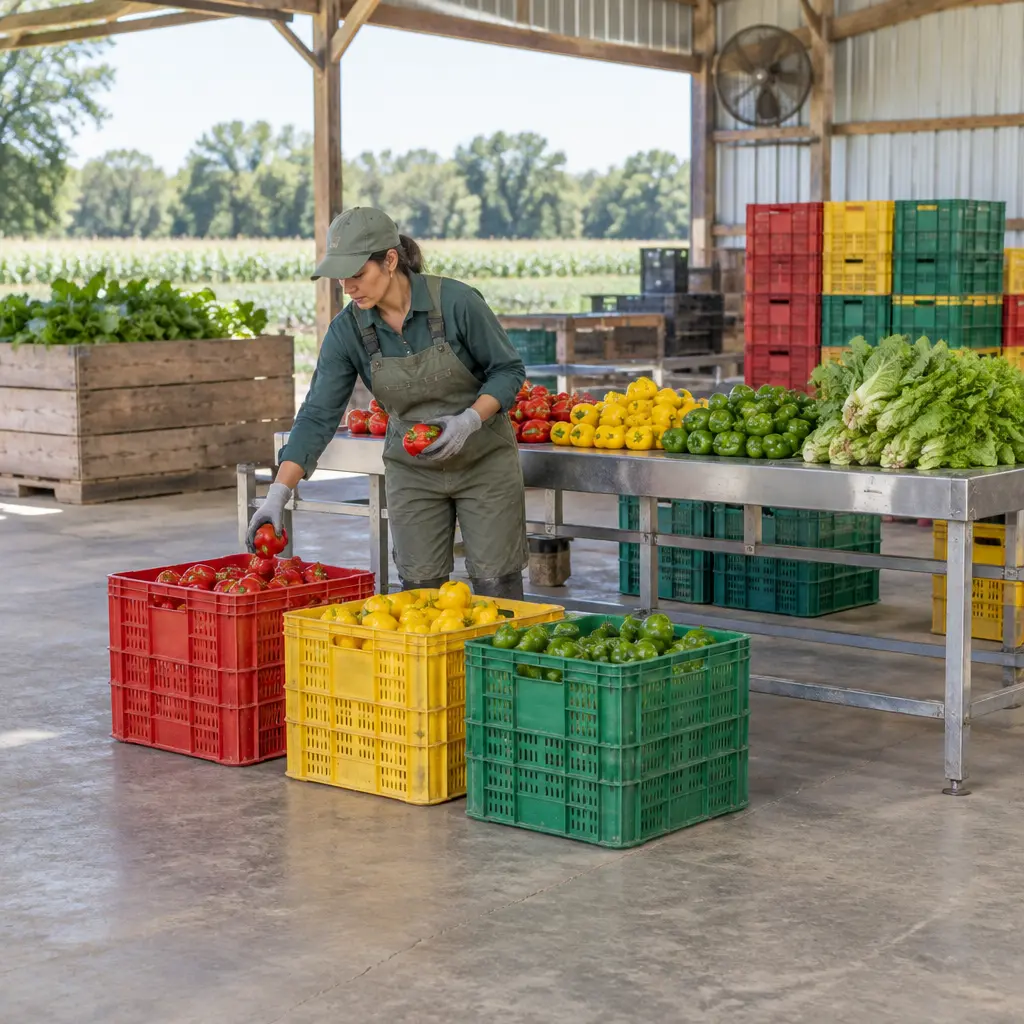
Cooperative food networks are groups of producers, workers, buyers, and community organizations that coordinate how food is grown, handled, sold, or distributed. Shared grading and packing standards are agreed rules for sorting food by attributes such as size, maturity, appearance, safety, and packaging. They help cooperatives combine products from multiple suppliers into predictable, marketable lots. The USDA’s Agricultural Marketing Service publishes voluntary U.S. grade standards for many commodities, while the Food and Agriculture Organization (FAO) identifies common standards and quality controls as important tools for market access and food loss prevention. For cooperatives, the practical challenge is to make these rules consistent without excluding small or diverse producers: clear specifications, affordable packing systems, reliable verification, and transparent decisions are all essential.
Shared grading and packing standards define cooperative quality
A grading standard classifies produce against defined quality criteria; a packing standard specifies how accepted produce is prepared, protected, labeled, and presented for transport or sale. The USDA Agricultural Marketing Service describes its commodity grade standards as voluntary benchmarks for quality and condition, generally intended to facilitate trade rather than replace food-safety law. In a cooperative, “shared” means that participating members apply the same documented rules and use agreed methods to assess results.
These standards can cover a range of related practices: visual grades for size and appearance, maturity or ripeness specifications, defect tolerances, pack sizes, container strength, labeling, and temperature or handling requirements. They are not interchangeable with food-safety plans. A product can meet a visual grade while still requiring separate controls for hygiene, traceability, and hazards.
Grades classify products for a stated market
A grade is a defined category, not a general claim that food is “good” or “bad.” For example, standards may distinguish lots by size, shape, color, maturity, condition, and the amount of permitted damage. The USDA’s standards for fruits and vegetables provide commodity-specific criteria, so cooperatives need to identify the relevant crop and buyer specification instead of applying one universal grading rule.
Grades can support consistent pricing and reduce disputes when members and buyers use the same definitions. They can also create unintended exclusion if cosmetic requirements are stricter than a product’s intended use warrants. A cooperative can address this by establishing separate outlets or categories—such as fresh-market, processing, and secondary-grade produce—where safe, usable food can find an appropriate market.
Packing standards protect quality and communicate identity
Packing standards specify matters such as pack weight, count, container type, arrangement, labeling, and lot identification. Appropriate packaging helps limit bruising and contamination and makes products easier to store, transport, and receive. FAO guidance on post-harvest handling emphasizes that damage, unsuitable handling, and poor storage conditions contribute to food loss; packaging is therefore part of quality management, not merely presentation.
A shared pack specification also helps a cooperative deliver a consistent order when the produce comes from many farms. It should state who supplies packaging, how tare weight is handled, which labels are permitted, and how each lot is identified. Packaging choices must also fit the crop, destination, and applicable rules; a container that works for sturdy roots may be unsuitable for delicate berries.
Shared standards strengthen coordination across cooperative food networks
A cooperative aggregates products that may differ because of variety, weather, soils, harvest timing, and farm practices. Common specifications translate that biological variation into workable commercial decisions. The central benefit is coordination: members know what to harvest and deliver, packhouse workers know how to sort and prepare it, and buyers know what to expect.
Standards are most useful when they are designed around actual routes to market. A wholesale buyer may require uniform cases and formal lot records, while a community-supported agriculture program may prioritize seasonal diversity and flexible pack sizes. Cooperative rules can support both by defining a baseline shared process and allowing documented, market-specific add-ons.
Aggregation makes consistency commercially valuable
Aggregation is the pooling of products from multiple members to meet buyer volumes or distribution needs. When incoming produce is graded and packed consistently, the cooperative can assemble larger, more predictable lots and reduce the time buyers spend checking deliveries. This can improve reliability, although it does not guarantee a higher price: the result depends on demand, costs, bargaining power, and whether buyers value the specification.
The USDA’s Agricultural Marketing Service presents grade standards as aids to orderly marketing and common understanding. In cooperative practice, the standards should therefore be linked to written buyer requirements and reviewed when markets change. A cooperative that invests in a premium grade without confirming buyer demand may increase labor and reject rates without gaining a corresponding return.
Transparent rules build trust among members
Transparent grading means that members can see the criteria, understand who applies them, and challenge or review a decision through a fair process. This matters because grading affects payment, acceptance, and access to markets. A written defect guide, sample images, calibration sessions, and retained records can help different graders reach similar decisions.
The cooperative should explain whether payment is based on weight, grade, pack-out percentage, or a combination. It should also document how rejected or downgraded produce is handled. These measures make quality control more credible and help identify whether recurring problems come from field conditions, harvest timing, transport, or inconsistent inspection.
Implementation connects grading and packing to safety and loss prevention
A workable standard is specific enough to guide decisions but affordable enough for members to follow. Implementation combines written requirements with training, inspection tools, packing facilities, records, and a process for updating rules. It should also distinguish commercial quality criteria from legally required food-safety controls, which may vary by product, activity, and jurisdiction.
FAO’s work on food loss and waste treats losses as occurring throughout supply chains, including handling, storage, and distribution. Shared procedures can help cooperatives spot avoidable damage and route products to suitable uses. They cannot eliminate losses by themselves: infrastructure, market access, labor, transport, and storage conditions remain decisive.
Training and calibration make standards repeatable
Calibration is the process of aligning graders’ decisions against agreed examples or reference samples. A cooperative can conduct short training sessions at the start of a season, record common defects, and periodically compare results between graders. For crops whose maturity changes rapidly, the standard may need to include harvest windows or ripeness indicators as well as appearance.
Simple tools can improve repeatability: scales, sizing rings, color references, defect charts, and checklists. The appropriate level of equipment depends on the crop and market. Recording a small sample of inspection results can show whether one shift or location is applying the rules differently and where additional training is needed.
Traceability and food safety require separate, linked controls
Traceability is the ability to identify a product’s origin and movement through the supply chain. Lot codes on cases can connect packed produce to a member, harvest date, and packing run, supporting inventory control and targeted response if a concern arises. The U.S. Food and Drug Administration’s Food Traceability Rule establishes additional recordkeeping requirements for certain foods on the Food Traceability List; applicability depends on the food and the businesses involved.
Grading does not establish that food is safe. Cooperatives should maintain applicable sanitation, water, worker-hygiene, and preventive-control practices independently of cosmetic or size specifications. Linking lot identification to both quality checks and safety records can make investigations more efficient while preserving the distinction between the two systems.
Inclusive specifications can reduce avoidable rejection
An inclusive standard recognizes that not every market needs identical appearance or packaging. A cooperative can set a clear primary grade while creating secondary channels for products that are safe and fit for processing, food service, donation, or direct sale under appropriate requirements. This approach can improve utilization, but it requires realistic demand, suitable handling, and transparent accounting of the extra labor and transport involved.
The European Commission’s Farm to Fork Strategy identifies food loss and waste reduction as a policy priority, while FAO research documents the importance of losses at different stages of food supply chains. These broad findings do not predict how much any one cooperative will save. Local measurement—tracking incoming volume, accepted volume, downgraded volume, and final destination—is needed to determine whether a revised grading rule actually reduces waste.
A cooperative can adopt standards through a measured process
Standards work best when members participate in their design and the cooperative measures their effects. A practical rollout starts with buyer and member needs, tests draft rules on real lots, estimates costs, and revises the specification before making it routine. Results should be reviewed across seasons because crop conditions, labor availability, packaging costs, and market requirements change.
- Map buyers, crops, delivery routes, and current points of rejection or damage.
- Write crop-specific grade and pack specifications, distinguishing required safety controls from market preferences.
- Test the rules with representative members and buyers, including small-volume and less-uniform lots.
- Train graders and packers, then record decisions, labor time, accepted volume, and product destinations.
- Review costs and outcomes with members and revise the standards through an agreed governance process.
A simple chart can make the system visible: show the share of incoming produce accepted for the main grade, redirected to another market, donated where appropriate, or discarded. Comparing those shares before and after a change helps distinguish genuine improvement from a mere shift in classification.
Conclusion: shared standards support reliable and fair food networks
Shared grading and packing standards give cooperative food networks a common language for quality, aggregation, and delivery. Grades classify products for particular uses; packing rules protect and identify them; training and transparent governance make decisions more consistent; and linked traceability and safety controls support responsible handling. Standards can improve coordination and help prevent avoidable loss, but they deliver value only when they fit buyers’ needs, members’ capacities, and the realities of each crop.
Cooperatives considering new rules should begin with member consultation, use relevant official commodity standards as references, pilot the specifications, and measure acceptance, cost, and product destinations. Further reading from USDA Agricultural Marketing Service, FAO, and FDA can help organizations distinguish voluntary market grades from food-safety and traceability obligations.
Sources: USDA Agricultural Marketing Service, U.S. Grade Standards, https://www.ams.usda.gov/grades-standards; Food and Agriculture Organization of the United Nations, The State of Food and Agriculture 2019: Moving Forward on Food Loss and Waste Reduction, https://www.fao.org/3/ca6030en/ca6030en.pdf; European Commission, Farm to Fork Strategy, https://food.ec.europa.eu/horizontal-topics/farm-fork-strategy_en; U.S. Food and Drug Administration, Food Traceability Rule, https://www.fda.gov/food/food-safety-modernization-act-fsma/food-traceability-rule