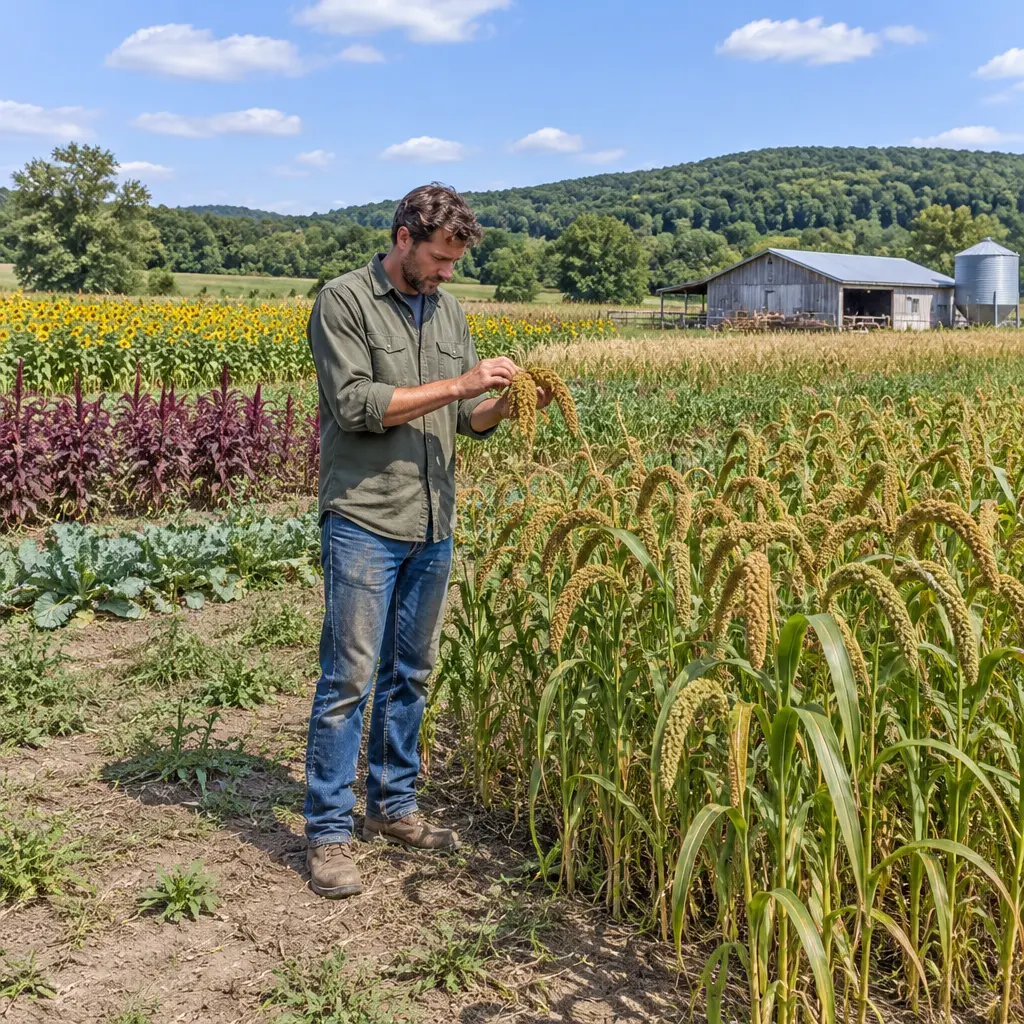
Non-GMO specialty grains are distinctive grain varieties developed, selected, or grown for qualities such as flavor, nutrition, local adaptation, or particular culinary uses, without genetic engineering as defined by applicable regulations. Their benefits can include greater crop and dietary diversity, access to specialty flavors and textures, and potential market opportunities for growers. Those advantages depend on the grain, farming system, processing, and buyer: “non-GMO” alone does not establish that a food is more nutritious, safer, or more sustainable. Understanding what the term means, which grains it covers, and what the evidence supports helps consumers and food businesses make informed choices.
What Non-GMO Specialty Grains Mean for Crop Diversity
A specialty grain is a grain marketed or cultivated for a distinctive attribute or use rather than solely as a commodity. Examples include ancient grains, heritage varieties, regionally adapted crops, and grains selected for traits such as unusual color or baking performance. “Non-GMO” generally indicates that the product was not produced using genetic engineering within the scope of a particular standard or law. Definitions and verification requirements differ by jurisdiction and certification program, so the label should be interpreted according to its stated rules.
The Food and Agriculture Organization of the United Nations (FAO) describes agricultural biodiversity as the variety and variability of animals, plants, and microorganisms used directly or indirectly for food and agriculture. Specialty grains can contribute to that diversity when they preserve or bring back distinct varieties and crops. However, a grain’s specialty status does not itself prove that it is a traditional variety, locally adapted, organically grown, or beneficial to biodiversity; those claims need separate evidence.
Ancient and Heritage Grains
“Ancient grain” is a popular food-market term, not a single technical or regulatory category. It commonly refers to grains and grain-like crops with a long history of cultivation, including sorghum, millet, teff, quinoa, and certain forms of wheat such as einkorn and emmer. Heritage grains generally refer to older varieties maintained for their historical, regional, or distinctive agricultural qualities. These terms describe history or market positioning; they do not by themselves guarantee a specific nutrient profile or farming method.
The distinction matters because nutrition varies by species, variety, milling, and preparation. The Whole Grains Council identifies many ancient grains as whole-grain choices when their bran, germ, and endosperm remain intact. For shoppers, the ingredient list and whole-grain claim provide more useful information about a particular product than the words “ancient” or “heritage” alone.
Underutilized and Regionally Adapted Grains
Underutilized grains are crops with food or farming potential that receive less production, research, or market attention than major commodities. Millet, sorghum, and teff are important foods in several regions, while in other markets they may be specialty ingredients. Their cultivation can broaden crop choices, but whether a particular crop performs well under heat, drought, or poor soils depends on species, variety, local conditions, and management.
The FAO’s work on neglected and underutilized species emphasizes their potential contribution to more diverse food systems, while also recognizing barriers such as limited seed access, processing infrastructure, and consumer demand. Buying a regionally grown grain can support local supply chains when the grain is actually produced nearby; the product name alone is not proof of local origin.
How Non-GMO Specialty Grains Support Dietary Variety
Dietary variety is one practical benefit of specialty grains. Different grains offer different flavors, textures, cooking properties, and nutrient profiles, giving households and food businesses alternatives to familiar staples. The U.S. Dietary Guidelines for Americans recommend that at least half of consumed grains be whole grains. That advice concerns whole-grain composition—not whether a grain is genetically engineered or labeled non-GMO.
Whole-Grain Fiber and Nutrient Choices
A whole grain retains its bran, germ, and endosperm in their original proportions, or has those components recombined in equivalent proportions after milling, according to the Whole Grains Council’s definition. Because the bran and germ contain fiber and other nutrients, choosing an intact or whole-grain specialty grain can add dietary variety and fiber compared with a refined version of the same grain. The amount varies by crop and product, so nutrition facts and ingredient lists are the best guides.
The health evidence supports whole grains as part of a balanced eating pattern, not a special health effect from non-GMO status. The Harvard T.H. Chan School of Public Health notes that whole grains provide fiber and other nutrients and are associated with health benefits in dietary research. Such population-level associations do not mean that every specialty grain product is inherently healthier; added sugar, sodium, processing, portion size, and overall diet still matter.
Gluten-Free Options and Important Exceptions
Some specialty grains and grain-like seeds, including millet, sorghum, teff, and quinoa, are naturally gluten-free. They can help people seeking alternatives to wheat, barley, and rye. However, cross-contact during growing, transport, or processing can introduce gluten, so people with celiac disease should look for products that meet applicable gluten-free requirements and follow medical guidance.
Not every heritage or ancient grain is gluten-free. Einkorn, emmer, and other wheat types contain gluten and are not suitable for a gluten-free diet. The U.S. Food and Drug Administration defines “gluten-free” for foods bearing the claim as containing less than 20 parts per million of gluten. This is a gluten standard, not a non-GMO standard, and the two labels address different attributes.
How Specialty Grains Can Benefit Farmers and Food Systems
Specialty grains can create value through differentiated markets, crop rotation, and diversified sourcing. These outcomes are not automatic: growers need suitable seed, reliable buyers, appropriate equipment, and prices that cover production and handling costs. A crop’s environmental or economic performance should be assessed in its local context rather than inferred from the terms “specialty” or “non-GMO.”
Market Differentiation and Farm Income
A specialty grain may earn a premium when buyers value its taste, origin, processing qualities, or verified production attributes. Direct sales, regional milling, and contracts with bakeries or food manufacturers can connect growers with those buyers. But premiums vary and can be offset by smaller markets, cleaning and storage requirements, specialized equipment, or certification costs. Farmers should evaluate contracts and expected net returns rather than relying on a general assumption that non-GMO products always sell for more.
The USDA Economic Research Service’s reporting on organic agriculture illustrates a related market principle: certified production systems can have different costs, prices, and market structures from conventional production. Organic certification is separate from non-GMO status, however. A grain can be non-GMO without being organic, and organic certification does not mean every product has a specialty-grain variety.
Crop Rotation and Resilience
Adding a different grain to a rotation can alter planting and harvest timing, interrupt some pest or disease cycles, and diversify farm operations. The benefits depend on the crop and rotation design; a new crop may also require unfamiliar management or lack nearby processing capacity. The U.S. Department of Agriculture’s Natural Resources Conservation Service promotes crop rotation and diversification as conservation practices, while emphasizing that practices should be adapted to site conditions and production goals.
For example, a farmer considering millet or sorghum as an alternative crop would need to assess local rainfall, soil, seed availability, harvesting equipment, and market access. That practical evaluation is more meaningful than assuming a crop is drought-proof or environmentally superior based only on its reputation.
What Non-GMO Labels Do—and Do Not—Verify
Non-GMO labeling communicates a production attribute; it is not a comprehensive rating of food quality. In the United States, the National Bioengineered Food Disclosure Standard uses the term “bioengineered” for foods that contain detectable genetic material modified through certain laboratory techniques and that could not be created through conventional breeding or found in nature. The U.S. Department of Agriculture (USDA) administers the disclosure standard, which has specific definitions and exemptions.
Verification, Traceability, and Standards
A third-party non-GMO certification may require ingredient review, supplier documentation, and measures to reduce commingling, depending on the program. The Non-GMO Project Verified program, for example, describes a risk-based standard and product verification process. Certification is useful only when consumers understand which organization issued it and what its standard covers. It does not certify organic farming, local origin, whole-grain content, or superior nutrition unless those claims are separately verified.
U.S. bioengineered disclosure rules and private non-GMO certifications are not identical. A shopper comparing products should check the label, certification mark, ingredient list, and the certifier’s current requirements. Rules can differ across countries, making the place of sale and the applicable standard important context.
Non-GMO Is Not a Nutrition or Safety Guarantee
Non-GMO status does not, by itself, establish that a food is more nutritious, safer, less processed, or better for the environment. The National Academies of Sciences, Engineering, and Medicine concluded in its 2016 report that currently commercialized genetically engineered crops had not been shown to pose greater human-health risks than conventionally bred crops, while noting that effects should be assessed case by case. That conclusion does not determine the merits of every farming system or product, but it underscores why a non-GMO label should not be treated as a general health claim.
Environmental impacts likewise depend on the crop, production practices, land use, inputs, and supply chain. A diverse rotation or locally adapted variety may offer particular benefits in a given setting, but the label alone does not document them. Look for specific, verifiable claims—such as certified organic production, whole-grain ingredients, or a stated regional origin—when those are the qualities you want.
Conclusion: Choosing Specialty Grains with Evidence
Non-GMO specialty grains can expand crop and culinary diversity, provide whole-grain and gluten-free options where appropriate, and create differentiated opportunities for farmers and food makers. Ancient, heritage, underutilized, and regionally adapted grains are related but distinct categories, and their benefits depend on the actual crop and how it is grown, processed, and sold. Non-GMO status is a narrower production claim—not proof of superior nutrition, safety, sustainability, or local origin.
Consumers can start by trying a whole-grain specialty grain, checking nutrition and ingredient information, and confirming gluten-free or certification claims when relevant. Food businesses and growers can investigate local demand, seed and processing availability, and transparent verification before making product or production decisions. For further reading, consult USDA labeling guidance, the Whole Grains Council’s grain resources, and FAO materials on agricultural biodiversity.
Sources: Food and Agriculture Organization of the United Nations, Agricultural biodiversity, https://www.fao.org/biodiversity/en/; Food and Agriculture Organization of the United Nations, Future Smart Food: Rediscovering hidden treasures of neglected and underutilized species for Zero Hunger in Asia, https://www.fao.org/3/i6754e/i6754e.pdf; Whole Grains Council, What Are Whole Grains?, https://wholegrainscouncil.org/whole-grains-101/what-are-whole-grains; U.S. Department of Agriculture and U.S. Department of Health and Human Services, Dietary Guidelines for Americans, 2020–2025, https://www.dietaryguidelines.gov/; Harvard T.H. Chan School of Public Health, Whole Grains, https://nutritionsource.hsph.harvard.edu/what-should-you-eat/whole-grains/; U.S. Food and Drug Administration, Gluten-Free Labeling of Foods, https://www.fda.gov/food/food-labeling-nutrition/gluten-free-labeling-foods; U.S. Department of Agriculture, National Bioengineered Food Disclosure Standard, https://www.ams.usda.gov/rules-regulations/be; Non-GMO Project, Non-GMO Project Standard, https://www.nongmoproject.org/product-verification/non-gmo-project-standard/; National Academies of Sciences, Engineering, and Medicine, Genetically Engineered Crops: Experiences and Prospects, 2016, https://nap.nationalacademies.org/catalog/23395/genetically-engineered-crops-experiences-and-prospects; U.S. Department of Agriculture, Natural Resources Conservation Service, Conservation Crop Rotation, https://www.nrcs.usda.gov/; U.S. Department of Agriculture, Economic Research Service, Organic Agriculture, https://www.ers.usda.gov/topics/natural-resources-environment/organic-agriculture/.