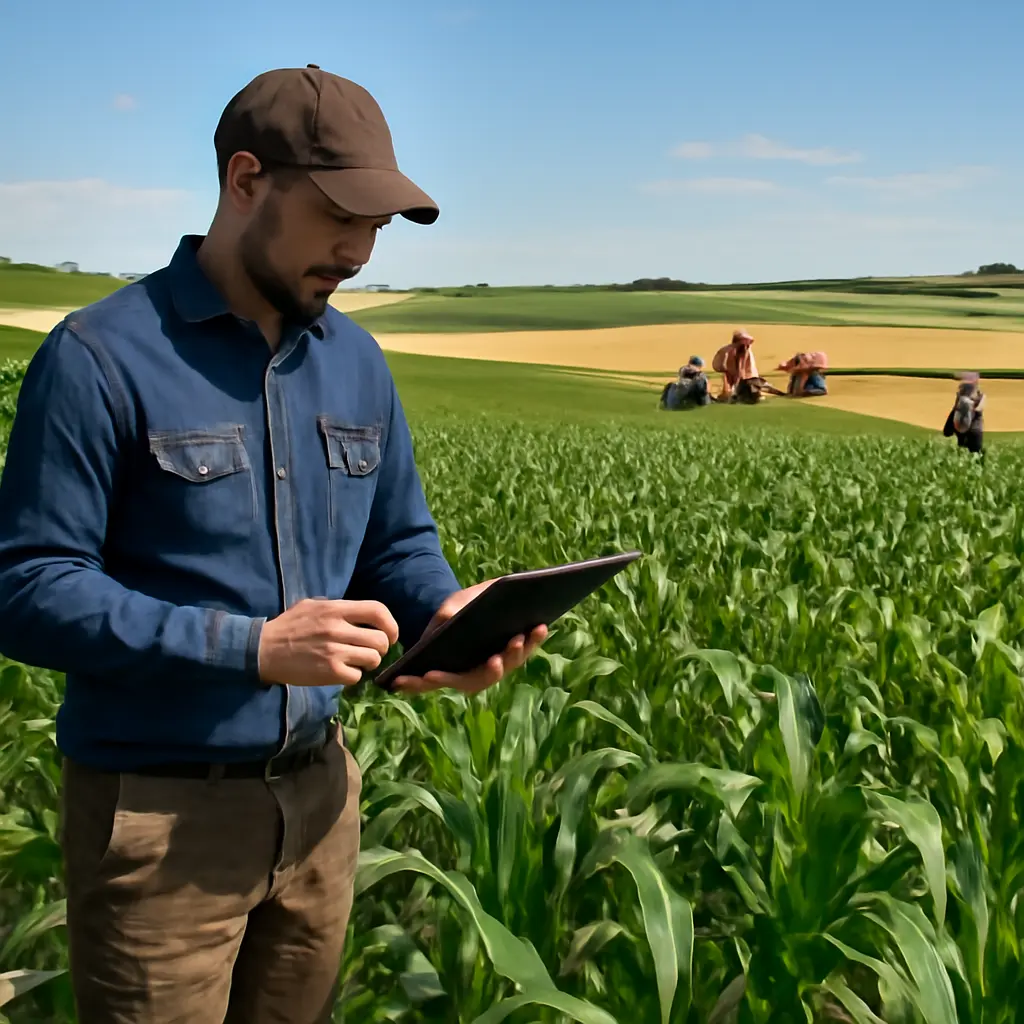
Cooperative harvest-window prediction combines growers’ local observations with weather forecasts, crop-development records, and shared decision-making to estimate when fields will be ready for harvest. It is not a guarantee of a perfect date: it is a way to reduce uncertainty, coordinate labor and machinery, and respond to changing conditions. The U.S. Department of Agriculture’s National Agricultural Statistics Service (NASS) reported that U.S. farms harvested 86.5 million acres of corn for grain in 2023, illustrating the scale of operations for which even modest improvements in timing can matter. A useful cooperative playbook links crop maturity, field and weather monitoring, shared forecasts, and practical harvest coordination—and checks each estimate against observations from the field.
Predicting harvest windows through cooperative crop intelligence
A harvest window is the period when a crop and its field conditions are suitable for the intended harvest, given quality requirements, equipment, and weather risk. The Food and Agriculture Organization of the United Nations (FAO) describes agricultural decision-support systems as tools that translate information into actionable decisions; applied cooperatively, the same principle means combining multiple farms’ observations and expertise rather than relying on one forecast or one calendar date.
The approach is valuable because harvest readiness is shaped by interacting variables: crop maturity, moisture, temperature, rainfall, soil trafficability, and the availability of labor and machinery. The National Oceanic and Atmospheric Administration (NOAA) provides forecasts and climate information that can inform short-term planning, while NASS crop progress reports offer regional context. Neither replaces field inspection. A cooperative’s strongest estimate joins broad-area signals to local evidence and updates the plan as conditions change.
Defining the cooperative harvest-window prediction playbook
The cooperative playbook is a repeatable process for pooling crop, weather, and operational information; estimating likely harvest periods; and coordinating action among participating farms. It is a practical framework, not a single standardized scientific term. Its defining characteristics are shared data, locally checked forecasts, clear responsibility for updates, and contingency plans for uncertainty.
The playbook covers several related forms of prediction: biological maturity estimates, weather-based field-access forecasts, quality or moisture assessments, and cooperative scheduling. These are connected but not interchangeable. A crop may be physiologically mature while too wet to harvest efficiently, and a field may be ready while shared equipment is committed elsewhere. Moving from crop readiness to operational readiness therefore requires a common information flow.
Crop maturity and quality windows
A crop maturity window is the period in which development has reached the stage required for harvest, while quality remains acceptable for the crop’s end use. Indicators vary by crop: grain growers may track kernel development and grain moisture, while fruit and vegetable producers may assess size, color, firmness, soluble solids, or market specifications. Cooperative members should record the indicator, sampling location, and date so that estimates can be compared consistently.
The USDA Risk Management Agency’s crop-specific production guidance and land-grant university extension services provide maturity and harvest recommendations tailored to local crops. The key implication is that a shared calendar should be treated as an initial cue, not proof of readiness: field sampling and buyer or storage requirements determine whether a crop is within its acceptable quality window.
Weather and field-access windows
A field-access window is the period when weather and soil conditions allow machinery to enter and operate without unacceptable delays, crop loss, or soil damage. Rainfall probability, temperature, humidity, wind, and soil moisture all matter, but their significance depends on soil type, drainage, crop, and equipment. NOAA forecasts can help identify likely rain or temperature shifts; local rain gauges and field observations help determine whether a specific field is actually trafficable.
The USDA’s National Agricultural Statistics Service publishes weekly crop progress and condition reports during the growing season. These reports are useful for comparing regional development with recent years, but they do not predict the readiness of a particular farm. A cooperative can use regional progress as a benchmark, then refine it with member-reported crop stages and field conditions.
Shared forecasting and confidence levels
A shared harvest forecast is a cooperative estimate of when participating fields are likely to be ready, accompanied by an explicit indication of uncertainty. Rather than reporting a single date as certain, members can use a range—such as an earliest plausible date, a most likely period, and a later contingency period—and state what evidence would change the estimate.
This distinction is important because weather forecasts become less certain further into the future, while crop development can vary across fields. The National Weather Service communicates forecast probabilities to represent uncertainty; cooperatives can adopt the same discipline by recording confidence and update times. A forecast that says “likely within the next week, pending drying” is more decision-useful than an unsupported exact date.
Building the cooperative prediction workflow
Once the relevant prediction types are clear, a cooperative can turn them into a repeatable workflow. The aim is not to collect every possible measurement, but to gather enough consistent information to make timely decisions and revise them when conditions shift.
Collect comparable field observations
Members should agree on a small shared record: field identifier, crop and variety, planting date, observed development stage, moisture or quality readings where relevant, recent rainfall, field access, and the date of observation. Standard definitions reduce ambiguity—for example, members should clarify whether “ready” means biologically mature, within a moisture target, or ready for machinery.
The FAO’s guidance on agricultural data and digital services emphasizes that information is useful only when it is relevant and interpretable. In practice, a simple shared spreadsheet or cooperative platform with consistent units and timestamps may be more valuable than a sophisticated dashboard fed by incomplete or incompatible records.
Combine field evidence with forecasts
The cooperative should compare crop observations with forecast temperature, rainfall, and other relevant conditions, then assess whether the forecast supports a harvest opportunity. For grain, this may include tracking drying conditions and moisture targets; for fresh produce, it may include heat, rain, and cooling or transport capacity. Forecasts should be checked against more than one reputable source when a major operational decision depends on them.
A useful daily or twice-weekly update records what changed since the prior assessment: new field samples, forecast shifts, rainfall received, equipment status, or buyer requirements. This makes the estimate auditable and helps the group learn whether its local indicators are reliable over time.
Coordinate labor, equipment, storage, and buyers
Operational coordination translates a readiness forecast into a workable sequence. Cooperatives can rank fields by urgency, quality risk, distance, expected harvest rate, and equipment needs, then reserve machinery, labor, transport, and storage accordingly. This is especially important where equipment is shared or where harvest capacity is limited by drying, cooling, packing, or delivery.
The USDA Census of Agriculture provides national data on farm structure and machinery, while local cooperative records reveal the actual capacity constraints members face. A regional acreage figure cannot determine a cooperative’s schedule; the relevant calculation is whether available harvesting and post-harvest capacity can process the expected volume within the crop’s quality window.
Managing uncertainty and validating predictions
A prediction is valuable only if the cooperative tests it against outcomes. Recording forecast dates alongside actual start dates, harvest conditions, yields, quality, and delays helps distinguish a useful model from a confident but inaccurate one. Validation also shows whether forecast errors arise from crop-stage estimates, weather changes, field access, or logistics.
Use scenarios and trigger points
Scenario planning prepares the group for more than one plausible outcome. A cooperative might define a normal-weather plan, a wet-weather plan, and a rapid-maturity or heat-stress plan. Each scenario should include trigger points, such as a measured moisture threshold, a forecast rainfall probability, a quality test, or a machinery availability change.
The National Drought Mitigation Center’s U.S. Drought Monitor illustrates how multiple indicators can be combined to describe evolving conditions. Harvest planning can use a similar principle at farm scale: no single indicator should control the decision when several interacting risks are present. Members should document which trigger led to a schedule change.
Track forecast performance and losses
Performance tracking compares predicted windows with actual harvest dates and outcomes. Useful measures include the average difference between predicted and actual start dates, the share of fields harvested within the predicted range, weather-related downtime, rejected or downgraded product, and avoidable equipment idle time. The cooperative should interpret these metrics by crop and season because a forecast method that works for one crop may not work for another.
For example, a cooperative growing grain and fresh vegetables should not assume that the same lead time or quality indicator applies to both. Grain planning may emphasize moisture, drying capacity, and storage; perishable produce planning may place greater weight on maturity, cooling, labor, and delivery schedules. Reviewing results after each season helps members improve sampling protocols and identify where additional sensors or expert advice could pay off.
A practical example and implementation checklist
Consider a hypothetical grain cooperative whose members expect several fields to reach harvest readiness within the same week. Members submit comparable maturity and moisture observations, the coordinator checks regional crop progress and the NOAA forecast, and the group sees a likely dry interval followed by rain. The cooperative prioritizes fields with the greatest quality or lodging risk, assigns shared machinery, confirms drying and storage capacity, and keeps a later contingency slot. If rainfall arrives early, the plan is revised using updated field-access reports rather than relying on the original date.
This example illustrates the playbook’s central value: it connects crop biology to weather and then to collective capacity. A cooperative beginning the process can use the following checklist:
- Agree on what “harvest-ready” means for each crop and market.
- Standardize field observations, measurement units, and update frequency.
- Combine local observations with reputable weather and regional crop information.
- Publish a date range and confidence level, not just a single date.
- Coordinate equipment, labor, transport, storage, and buyer requirements.
- Record actual outcomes and review prediction accuracy after harvest.
Conclusion: Make the harvest window a shared decision
Cooperative harvest-window prediction brings together crop maturity, field access, weather forecasts, and shared operational scheduling. Its strongest features are consistent observations, transparent uncertainty, clear trigger points, and post-harvest validation. Regional statistics and forecasts provide context, but local field evidence remains essential because readiness varies within and between farms.
The broader benefit is better coordination under changing conditions: members can prepare labor and machinery, protect crop quality, and make timely adjustments rather than reacting in isolation. Cooperatives should begin with a small set of shared indicators, review their accuracy each season, and consult local extension specialists for crop-specific thresholds. The result is not a perfect prediction, but a more informed and adaptable harvest plan.
Sources: U.S. Department of Agriculture, National Agricultural Statistics Service, 2023 State Agriculture Overview: United States, https://www.nass.usda.gov/Quick_Stats/Ag_Overview/stateOverview.php?state=UNITED%20STATES; U.S. Department of Agriculture, National Agricultural Statistics Service, Crop Progress and Condition, https://www.nass.usda.gov/Publications/Subscribe_to_NASS_Reports/; National Oceanic and Atmospheric Administration, National Weather Service, Forecasts, https://www.weather.gov/; Food and Agriculture Organization of the United Nations, Digital Agriculture, https://www.fao.org/digital-agriculture/en/; U.S. Department of Agriculture, Risk Management Agency, Crop Policies and Provisions, https://www.rma.usda.gov/policy-procedure; National Drought Mitigation Center, U.S. Drought Monitor, https://droughtmonitor.unl.edu/; U.S. Department of Agriculture, National Agricultural Statistics Service, 2022 Census of Agriculture, https://www.nass.usda.gov/Publications/AgCensus/2022/