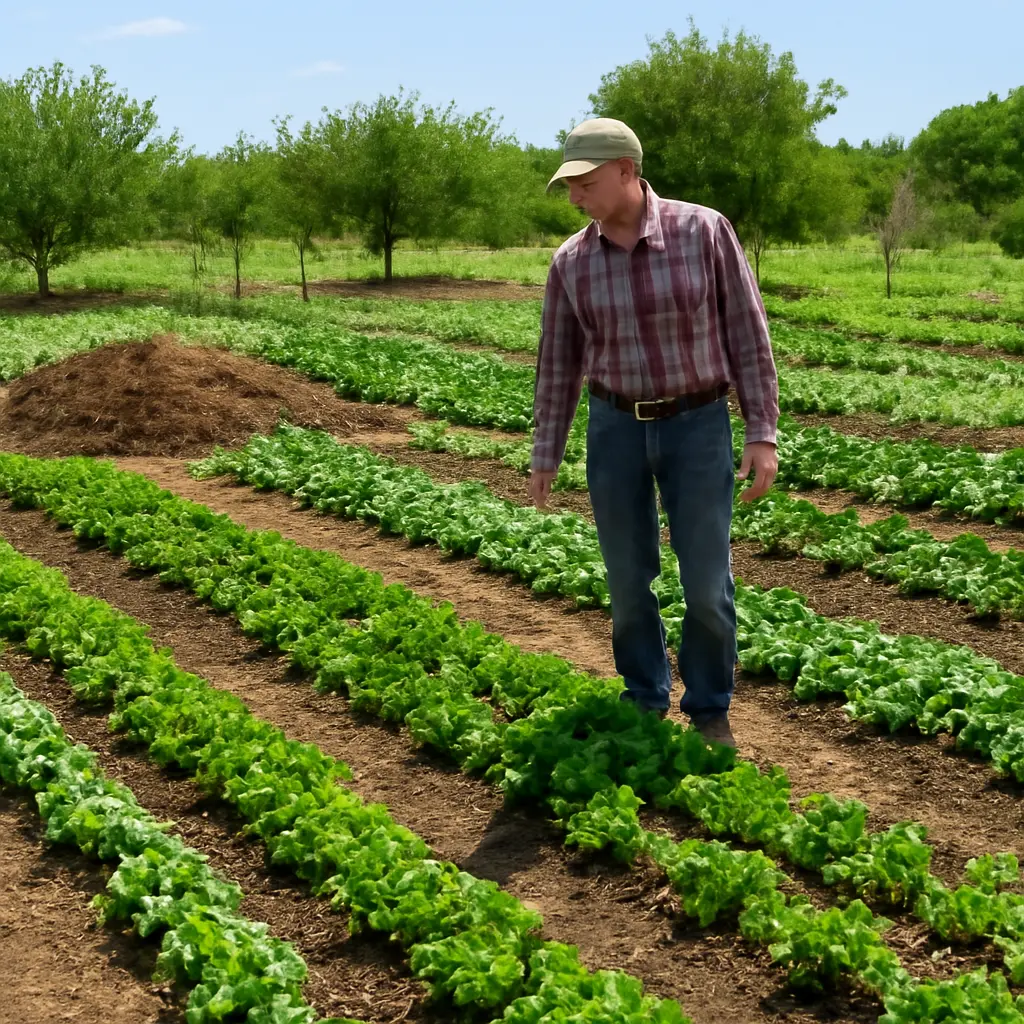
A family farm is an agricultural operation owned or managed by a family, often combining household labor, local knowledge, and stewardship of land and resources. Growing food responsibly on limited land means producing useful harvests while protecting soil, using water efficiently, supporting biodiversity, and keeping the farm economically viable. The approach is increasingly relevant: the UN Food and Agriculture Organization (FAO) estimates that family farms make up about 90% of the world’s farms and produce roughly 80% of the world’s food by value. On a small acreage, practices such as crop rotation, composting, careful irrigation, mixed planting, and direct sales can help balance productivity with long-term care of the land.
Responsible food growing defines the family farm’s limited-land approach
Responsible food growing is a way of managing crops, livestock, soil, water, and farm finances so that food is produced without needlessly degrading the resources future harvests depend on. The FAO describes sustainable food and agriculture as productive and resilient while conserving, protecting, and improving natural resources. For a family farm, this is not a single technique or certification: it is a set of practical decisions adapted to local soil, climate, labor, markets, and available acreage.
Limited land makes careful planning especially important. The United States Department of Agriculture (USDA) reported that 88% of U.S. farms were small family farms in its 2021 farm typology, while small family farms accounted for 22% of the value of agricultural production. These figures describe U.S. farms, not farms worldwide, but they illustrate why land-efficient methods and viable routes to market matter to many family operations.
Soil health is the farm’s productive foundation
Soil health refers to the soil’s continuing capacity to function as a living ecosystem that sustains plants, animals, and people. USDA’s Natural Resources Conservation Service (NRCS) emphasizes that healthy soil supports water infiltration, nutrient cycling, root growth, and biological activity. Family farmers can build these functions through practices such as keeping soil covered, reducing unnecessary disturbance, rotating crops, and returning organic matter through compost or crop residues.
These practices work together rather than as isolated fixes. A winter cover crop can protect bare ground, capture nutrients that might otherwise leach away, and add roots and biomass. A rotation that alternates plant families can interrupt some pest and disease cycles and distribute nutrient demands across seasons. Results depend on soil type, weather, crop choice, and management; soil tests and field observations help families adjust instead of applying inputs by habit.
Water efficiency protects crops and watersheds
Water-efficient farming supplies crops with the water they need while limiting losses through evaporation, runoff, or excessive application. Drip irrigation delivers water near plant roots and can be useful for high-value vegetables on small plots; mulches and organic matter can also help conserve moisture. The USDA Climate Hubs recommend matching irrigation decisions to crop needs, soil conditions, and weather rather than watering on a fixed schedule.
Efficiency should be checked in the field: clogged emitters, uneven pressure, or overwatering can waste water even when a system is designed for precision. Rain gauges, soil-moisture checks, and simple irrigation records help identify problems. Responsible water management also includes preventing fertilizer, manure, and soil from washing into streams or wells through appropriate application timing, vegetated field edges, and erosion control.
Land-efficient production combines intensive planning with ecological care
Land-efficient production means arranging crops and farm activities to make good use of the available area without assuming that maximum output per acre is the only measure of success. The best fit depends on a family’s goals: a compact vegetable operation may prioritize frequent harvests and direct sales, while a mixed farm may allocate space to pasture, grains, orchards, and habitat. The bridge between productivity and stewardship is deliberate design—choosing what to grow, where to grow it, and how each crop supports the next.
Crop rotation and intercropping spread risk
Crop rotation is the planned sequence of different crops on a field over time. Intercropping grows two or more crops together or in close succession. Both approaches can diversify harvests and make use of different rooting depths, growing seasons, or nutrient needs. For example, a family farm might rotate a heavy-feeding vegetable with a legume cover crop, or plant a quick-growing crop between wider-spaced rows while the main crop establishes.
Diversification can help reduce dependence on one crop, but it also adds planning and labor demands. The USDA’s Agricultural Research Service notes that diversified rotations can improve soil and help manage pests in suitable systems. Farmers should select combinations based on local growing conditions and market demand, and avoid treating any one crop pairing as universally beneficial.
Agroforestry and perennial crops add layers of production
Agroforestry intentionally combines trees or shrubs with crops, livestock, or both. Examples include windbreaks, alley cropping, silvopasture, and riparian buffers. The USDA National Agroforestry Center describes these systems as ways to integrate trees with agriculture for multiple products and benefits, such as shade, erosion control, habitat, and additional income. On a small farm, a hedgerow or fruit-tree strip can serve several purposes, though it requires appropriate species selection and a long-term maintenance plan.
Perennial crops, including berries, fruit trees, and perennial herbs, remain in place for multiple years and can reduce repeated soil preparation. They may spread harvest periods and diversify farm products, but they can also take time to establish and may need specialized pruning, pest management, or equipment. A realistic plan weighs those start-up costs against expected yields and the family’s available labor.
Protected cultivation can extend the season
Protected cultivation uses structures such as high tunnels, greenhouses, or low tunnels to modify growing conditions. A high tunnel is typically an unheated, plastic-covered structure that can protect crops from wind and rain and extend the growing season. USDA’s Natural Resources Conservation Service supports high-tunnel systems through conservation programs, reflecting their potential to help producers manage weather exposure and improve production opportunities.
Structures are not a shortcut around sound farm planning. Ventilation, irrigation, crop rotation, sanitation, and temperature management remain important, and construction costs may be substantial. Before investing, families can compare expected market prices and harvest windows with labor, materials, water needs, and the structure’s useful life.
Family-farm stewardship links biodiversity, livestock, and livelihoods
A responsible small farm considers the whole system: crops, beneficial organisms, livestock where present, household labor, and the communities that buy its food. The FAO’s family-farming framework recognizes family farms as diverse operations that are closely connected to local social and ecological conditions. That makes farm-level choices—such as maintaining habitat or selling through local channels—part of both land stewardship and business resilience.
Biodiversity supports beneficial farm functions
Biodiversity on a farm includes the variety of crops, livestock breeds, wild plants, pollinators, soil organisms, and other wildlife present in or around production areas. Flowering field margins, hedgerows, ponds, and staggered flowering crops can provide habitat and food for beneficial insects. The FAO identifies biodiversity as important to ecosystem services and resilient food systems, while the USDA encourages pollinator habitat practices that provide forage and nesting resources.
Habitat must be matched to local species and farm needs. A field edge can be useful, but it needs management to prevent invasive plants or unwanted pests from becoming a problem. Farmers can begin with a small area, choose locally appropriate native plants with staggered bloom times, and observe whether pollinator activity and beneficial insects increase.
Integrated pest management reduces avoidable inputs
Integrated pest management (IPM) is a decision-making approach that combines prevention, monitoring, and a range of control methods to manage pests while limiting risks to people and the environment. The U.S. Environmental Protection Agency describes IPM as an effective, environmentally sensitive approach that relies on current information about pest life cycles and their interaction with the environment. In practice, a family farmer might rotate crops, use resistant varieties, monitor pest levels, protect natural enemies, and apply a targeted pesticide only when justified.
Monitoring matters because the presence of a pest does not always mean that treatment is needed. Keeping simple records of pest pressure, weather, crop stage, and control results helps families refine decisions over time. When pesticides are used, label directions, protective equipment, and local regulations remain essential.
Livestock integration can recycle nutrients when carefully managed
Mixed crop-livestock farming combines animal production with crop production, often using pasture, crop residues, or manure within a coordinated nutrient plan. Well-managed grazing can make use of forage and return nutrients to fields; poorly managed grazing can compact soil, expose ground, and damage waterways. Rotational grazing plans therefore need to account for stocking rate, pasture recovery, soil conditions, and access to clean water.
Manure is a resource only when handled safely and applied at appropriate rates and times. The USDA and the U.S. Environmental Protection Agency advise nutrient management practices that consider crop requirements, soil tests, storage, and runoff risk. Families without livestock can still build soil organic matter through compost and cover crops, so animal integration is an option rather than a requirement for responsible farming.
Local markets help connect stewardship with farm viability
Farm viability means that an operation can meet its costs, compensate labor, maintain equipment and land, and continue into the future. Direct-to-consumer channels—such as farmers markets, community-supported agriculture (CSA), farm stands, and local restaurant sales—can help some small farms capture more value per unit of production. USDA’s National Agricultural Statistics Service reported that U.S. farms sold $9 billion in food directly to consumers, retailers, institutions, and local distributors in the 2020 Census of Agriculture. This national figure includes several marketing channels and does not guarantee profitability for any individual farm.
A market plan should be developed alongside the growing plan. Families can estimate production costs, identify likely buyers, test demand with a modest crop area, and track labor and unsold produce. Diversified income may improve resilience, but it can also complicate harvest schedules, packing, delivery, and customer service.
A practical family-farm plan turns principles into measurable decisions
A workable plan starts with the land and the family’s capacity rather than with a long list of fashionable techniques. Soil tests, water availability, slope, sunlight, existing habitat, labor calendars, and nearby markets all shape what is appropriate. The following steps can help families begin without attempting to change the whole farm at once.
- Map fields, water sources, slopes, drainage, existing trees, and areas vulnerable to erosion.
- Test soil and identify the crops, livestock, or products that fit local conditions and realistic labor availability.
- Choose one or two improvements—such as a cover crop, crop rotation, drip irrigation, or a pollinator strip—and set a baseline for comparison.
- Track yields, input use, water, labor, sales, and soil or pest observations through the season.
- Review results with a local extension service or conservation adviser, then expand, revise, or stop practices based on evidence.
A simple comparison chart can make progress visible: list each field or crop, its soil-cover period, irrigation method, input costs, harvest value, and observations about pests or erosion. This is not a substitute for formal accounting or soil monitoring, but it helps families connect environmental goals with operational decisions.
Conclusion: responsible limited-land farming depends on steady learning
Responsible food growing on limited land brings together soil health, water efficiency, diversified production, biodiversity, integrated pest management, and a viable route to market. Family farms are diverse, so no single method fits every acreage or household. The strongest approach is to choose practices suited to local conditions, measure their effects, and adapt as the land, weather, labor, and markets change.
Families can begin with a soil test, a field map, and one manageable improvement, then seek guidance from a local agricultural extension office or conservation district. Continued learning helps protect productive land while supporting the people and communities who depend on it.
Sources: Food and Agriculture Organization of the United Nations, Family Farming Knowledge Platform, https://www.fao.org/family-farming/home/en/; Food and Agriculture Organization of the United Nations, Sustainability and Sustainable Food Systems, https://www.fao.org/sustainability/en/; U.S. Department of Agriculture Economic Research Service, America’s Diverse Family Farms: 2021 Edition, https://www.ers.usda.gov/publications/pub-details/?pubid=102747; USDA Natural Resources Conservation Service, Soil Health, https://www.nrcs.usda.gov/conservation-basics/natural-resource-concerns/soil/soil-health; USDA Climate Hubs, Irrigation Management, https://www.climatehubs.usda.gov/hubs/northeast/topic/irrigation-management; USDA Agricultural Research Service, Crop Rotation, https://www.ars.usda.gov/; USDA National Agroforestry Center, What Is Agroforestry?, https://www.fs.usda.gov/nac/; USDA Natural Resources Conservation Service, High Tunnel Initiative, https://www.nrcs.usda.gov/programs-initiatives/eqip-high-tunnel-initiative; U.S. Environmental Protection Agency, Integrated Pest Management (IPM) Principles, https://www.epa.gov/safepestcontrol/integrated-pest-management-ipm-principles; USDA National Agricultural Statistics Service, 2020 Census of Agriculture, https://www.nass.usda.gov/Publications/AgCensus/2022/Full_Report/Volume_1,_Chapter_1_US/