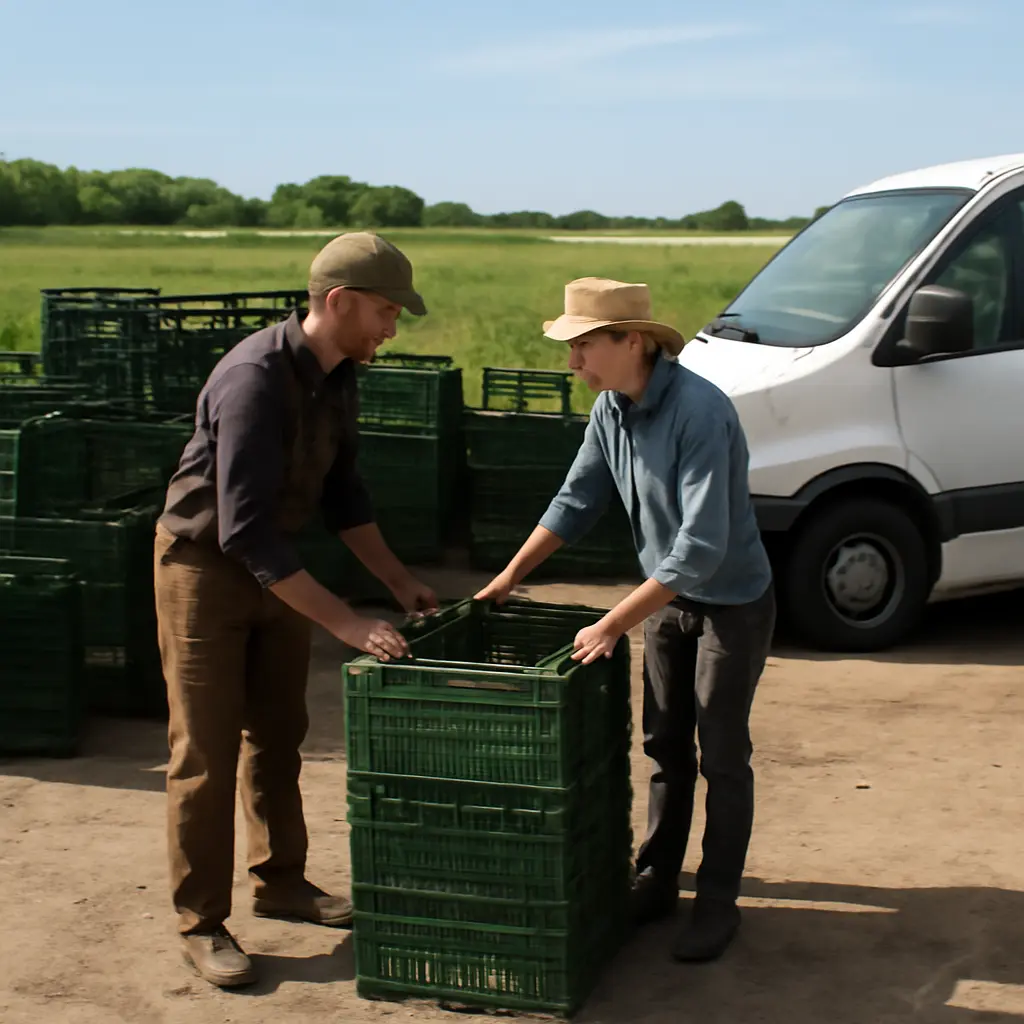
Small-scale farming networks work best when they make cooperation easy rather than building elaborate systems that farmers cannot maintain. These networks—local relationships through which growers share knowledge, equipment, labor, inputs, and routes to market—can reduce costs and strengthen resilience without requiring a complex organization. The U.S. Department of Agriculture’s 2022 Census of Agriculture counted about 1.9 million farms, with an average size of 463 acres, but small farms often have limited time and bargaining power on their own. Practical networks address those constraints through simple agreements, trusted communication, and a few shared priorities. The sections below explain what makes these networks work, which forms are useful, how to keep coordination manageable, and what real-world programs suggest about their potential.
Simple coordination strengthens small-scale farming networks
A small-scale farming network is a group of independent farms and related organizations that cooperate to solve shared problems while keeping each farm’s decision-making autonomy. The network may be informal, such as neighbors exchanging labor, or organized around a specific purpose, such as distributing food to local institutions. Its defining feature is not its size or legal structure, but the practical exchange of resources and information among participants.
The USDA’s National Agricultural Statistics Service reported approximately 1.9 million U.S. farms in the 2022 Census of Agriculture, down 6.9% from 2017. The census also reported that farms with less than $10,000 in sales made up a substantial share of farms, illustrating why individual producers may benefit from pooling selected services. A network cannot erase the pressures of low margins, labor shortages, or market concentration. It can, however, help farmers access opportunities that are difficult or costly to pursue alone.
The simplest useful networks tend to share three traits: a clear reason to cooperate, a manageable number of commitments, and communication that fits members’ working lives. Rather than begin with a large governance structure, farmers can identify one recurring bottleneck—such as delivery costs or access to specialized equipment—and build cooperation around it.
Shared resources make farming networks practical
Shared resources are the equipment, services, knowledge, and relationships that members make available to one another. The USDA’s National Institute of Food and Agriculture (NIFA) describes agricultural cooperation through programs that support producer groups, market development, and value-added enterprises. In everyday practice, resource sharing can be much less formal: neighboring growers might coordinate tractor use, buy packaging together, or exchange advice about a pest outbreak.
Useful forms of cooperation include equipment sharing, joint purchasing, labor exchanges, peer learning, and collaborative marketing. These are not interchangeable: each solves a different problem and requires a different level of coordination. A strong network chooses the smallest arrangement that can reliably deliver the intended benefit.
Equipment and infrastructure sharing
Equipment sharing means that multiple farms coordinate access to machinery or facilities that would be expensive or inefficient for each farm to own independently. Examples include a shared cooler, wash-and-pack station, seed drill, or delivery vehicle. The main benefit is better use of high-cost assets; the main risks are scheduling disputes, damage, maintenance costs, and unclear responsibility.
A brief written agreement can prevent these arrangements from becoming complicated. It should state who can use the asset, how bookings work, how fuel and repairs are paid, and what happens if equipment is damaged. Members can begin with a shared calendar and review the arrangement after a season. The USDA’s 2022 census reported that farms with direct-to-consumer sales represented a small but important part of the agricultural landscape, and infrastructure such as cold storage can help producers handle perishable products more reliably.
Joint purchasing and service access
Joint purchasing is the coordinated purchase of inputs or services to seek lower prices, reduce delivery costs, or improve access. A group might order compost, seed, feed, packaging, or fuel together. Pooling orders can strengthen negotiating power, but savings only materialize when members agree on specifications, payment timing, and delivery logistics.
The most workable approach is to start with one recurring purchase and compare the group price with each farm’s usual cost, including transport and coordination time. A shared spreadsheet or simple order form may be enough. If the group expands into cooperative ownership or resale, members should seek appropriate legal and accounting advice rather than assuming an informal arrangement covers every obligation.
Knowledge exchange and peer learning
Knowledge exchange is the sharing of practical experience, technical information, and problem-solving among farmers. It may occur through farm walks, short messaging groups, seasonal meetings, or one-to-one mentoring. These exchanges are especially valuable when growers face local conditions—such as soil type, weather patterns, or pest pressure—that general guidance may not fully capture.
The USDA’s Sustainable Agriculture Research and Education program supports farmer-driven research and education, including projects that test practices under real farm conditions. A network can apply the same learning principle on a smaller scale: identify a question, compare approaches, record a few useful observations, and share the results. Keeping discussions focused helps members learn without creating another administrative burden.
Resource sharing can lower the cost of operating, but market access is often the next constraint. Networks can address it by coordinating sales and delivery, provided they avoid promising more volume or consistency than their members can supply.
Local market coordination connects farms with buyers
Local market coordination is the process of aligning what farms produce with how buyers order, receive, and pay for food. It may involve shared delivery routes, a common ordering system, cooperative branding, or pooled sales to institutions. The aim is not necessarily to create a new organization; it is to make purchasing from multiple farms simpler for both growers and customers.
The USDA’s Agricultural Marketing Service supports local and regional food systems through programs and market information intended to connect producers with consumers and buyers. A network can put that principle into practice by beginning with a narrow product range, a dependable delivery day, and clear terms. Reliability is often more valuable to a buyer than an extensive catalogue that changes without notice.
Shared distribution and delivery routes
Shared distribution means coordinating the movement of products from several farms through a common pickup point, delivery route, or logistics provider. It can reduce duplicated trips and help smaller producers reach buyers that require consolidated deliveries. To work well, the group needs consistent packing standards, order deadlines, product identification, and a clear process for handling shortages or rejected goods.
A pilot route is a sensible first step. Participants can track distance, fuel, labor time, delivery reliability, and fees for several weeks, then decide whether the route produces a genuine net benefit. A chart comparing those measures before and during the pilot would make the trade-offs visible without requiring a complex software system.
Cooperative sales and institutional buyers
Cooperative sales allow farms to market products together while remaining independently owned. For instance, a group may coordinate orders from restaurants, schools, or grocery stores, with each farm supplying agreed quantities. The arrangement can make small farms more visible and offer buyers a single point of contact, but it also requires clear rules for pricing, product quality, invoicing, and payment distribution.
The USDA’s Farm to School Census documents the scale of school food purchasing and farm-to-school activity across the country. Such programs can create opportunities for regional producers, although school procurement often involves formal requirements for food safety, delivery, and contracting. A small network should therefore confirm buyer requirements early and avoid taking on a contract until members can meet its specifications consistently.
Community-supported agriculture and direct sales
Community-supported agriculture (CSA) is a direct-sales model in which customers buy a share of a farm’s expected harvest, usually receiving regular produce boxes during the season. Networks can coordinate pickup locations, combine products from several farms, or share customer communications. These arrangements can broaden product variety, but members need to agree on how harvest variability, substitutions, and customer service will be handled.
The USDA census tracks direct-to-consumer sales, including CSA activity, farmers markets, and farm stores. These channels can strengthen producer-customer relationships, but they do not automatically guarantee profitability. Before joining a shared sales effort, farmers should estimate packing and delivery labor, market fees, spoilage, and the time required to manage customer orders.
Because each market channel introduces its own obligations, a network’s long-term success depends on governance that clarifies responsibility without becoming a bureaucracy.
Lightweight governance keeps farming networks dependable
Lightweight governance is a small set of agreed procedures for making decisions, sharing costs, resolving disagreements, and reviewing results. It does not mean avoiding accountability. It means matching administrative effort to the scale and risk of the activity. Informal cooperation may need only a written schedule and cost-sharing rule, while a shared facility or sales contract may require formal agreements and professional guidance.
A practical network can make responsibilities explicit without creating unnecessary committees. Members should know who confirms orders, maintains shared equipment, keeps records, communicates changes, and follows up on payments. These tasks can rotate or be compensated, but they should not remain invisible work assigned by default to one person.
Clear agreements and fair cost sharing
A clear agreement records what members are contributing and receiving. For shared machinery, costs might be divided by hours of use; for a marketing service, they might be allocated by volume sold or a fixed seasonal fee. The fairest formula depends on the activity, so members should choose one they can explain and verify rather than adopting a complicated model they cannot administer.
Written terms should also cover withdrawal, late payment, equipment damage, confidentiality where relevant, and how the group will change its rules. For arrangements involving liability, employment, food safety, or substantial investment, local legal, insurance, and accounting advice can help members avoid preventable disputes.
Communication that fits farm schedules
Effective network communication is timely, concise, and accessible to members with different schedules and technology access. A group can use a shared calendar for bookings, a messaging channel for urgent updates, and a short seasonal meeting for decisions. Requiring members to check several platforms or attend frequent meetings can turn cooperation into extra work rather than a practical benefit.
One simple rule is to match the communication method to the task: use a calendar for reservations, a written record for decisions and costs, and direct contact when a change affects an order or delivery. A named coordinator can help, but the role should have defined duties and a reasonable workload.
Small pilots and regular evaluation
A pilot is a limited trial designed to test whether a cooperative activity works before members commit more resources. The group might share a cooler for one harvest period, coordinate a single delivery route, or place one joint input order. A pilot helps expose practical problems while the costs and stakes are still manageable.
Before starting, members can choose a few measures: cost per delivery, hours saved, equipment downtime, order fulfillment, or the number of buyers served. At the end of the trial, they can compare the results with the previous method and decide whether to continue, revise, or stop. This evidence-based approach keeps a network adaptable rather than locked into an arrangement simply because it took effort to establish.
These principles are visible in established regional food initiatives, where collaboration works best when it responds to a specific local need and grows in step with participants’ capacity.
Real-world programs show the value of focused cooperation
The USDA’s Local Food Promotion Program and Farmers Market Promotion Program support local and regional food marketing, planning, and market development. Their existence reflects a broader challenge: producers may need coordination, infrastructure, or market information to connect with buyers, but the right solution varies by region and product. These programs are examples of support available to eligible applicants, not guarantees that a network will succeed or qualify for funding.
Farm to school initiatives offer another example of how local producers may coordinate to serve a buyer with specific needs. Schools can create demand for regional food, but procurement schedules, food safety practices, quantity requirements, and delivery windows must be addressed. Producers may find that a shared ordering and delivery arrangement is more useful than creating a large new organization.
Farmer-led research and demonstration projects supported by USDA SARE also illustrate a low-complexity form of networking: producers test practices, exchange observations, and share lessons with peers. The transferable insight is straightforward. Cooperation can produce value through learning and coordination, not only through formal collective ownership.
Conclusion: keep small-scale farming networks focused
Small-scale farming networks work when they connect independent producers around problems that are worth solving together. Shared equipment, joint purchasing, peer learning, coordinated distribution, and cooperative sales each offer useful options, but none requires a complicated structure at the outset. Lightweight agreements, accessible communication, fair cost-sharing, and small pilots help members build trust while keeping the workload manageable.
The broader implication is that resilience can come from practical relationships as well as from individual investment. Farmers considering a network can start by naming one recurring constraint, inviting the people directly affected, and testing a simple solution for one season. Then measure the results and keep only what demonstrably saves time, reduces cost, improves market access, or strengthens learning. For further guidance, consult USDA resources on local food systems, farm-to-school purchasing, and SARE-supported farmer research.
Sources: U.S. Department of Agriculture, National Agricultural Statistics Service, 2022 Census of Agriculture, https://www.nass.usda.gov/Publications/AgCensus/2022/; U.S. Department of Agriculture, National Institute of Food and Agriculture, Sustainable Agriculture Research and Education (SARE), https://www.nifa.usda.gov/grants/programs/sustainable-agriculture-research-education-sare; U.S. Department of Agriculture, Agricultural Marketing Service, Local and Regional Food Sector, https://www.ams.usda.gov/services/local-regional; U.S. Department of Agriculture, Farm to School Census, https://farmtoschoolcensus.fns.usda.gov/; U.S. Department of Agriculture, Agricultural Marketing Service, Farmers Market Promotion Program, https://www.ams.usda.gov/services/grants/fmpp; U.S. Department of Agriculture, Agricultural Marketing Service, Local Food Promotion Program, https://www.ams.usda.gov/services/grants/lfpp.